
Blind-Spot Checks for NSW Learner Drivers: 10 Practical Rules
Learn ten practical rules for safer blind-spot checks when leaving the kerb, changing lanes and merging on NSW roads.
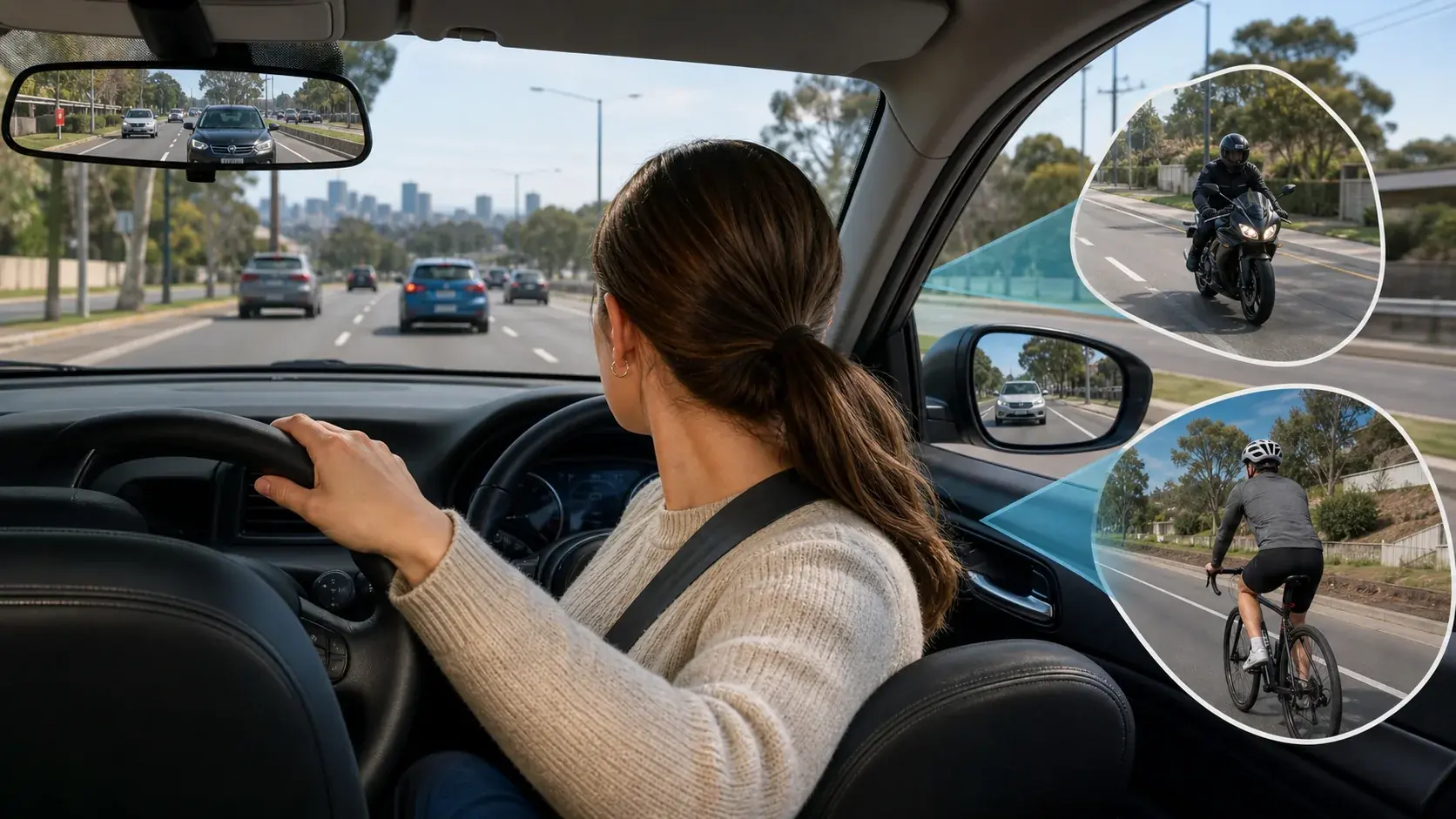
A vehicle can disappear from your mirrors without disappearing from the road. That is why safe observation involves more than glancing at the rear-view and side mirrors. Learner drivers need to recognise where vehicles and other road users may be hidden, then use a brief, purposeful head check before moving into that space.
In busy Sydney traffic, the hidden road user might be a motorcycle beside the car, a bicycle near the kerb or another vehicle in the next lane. These ten practical rules will help NSW learner drivers develop a consistent observation routine without looking away from the road ahead for too long.
Understanding mirrors, blind spots and head checks
Mirrors provide essential information behind and beside your vehicle, but they cannot show every surrounding area. A blind spot is an area outside the driver’s direct view that may not be visible in the mirrors. Its position and size can vary according to the vehicle, seating position and mirror adjustment.
A head check is a quick turn of the head towards the relevant side to confirm whether that hidden area is clear. It complements mirror use rather than replacing it. Effective observation combines awareness of the road ahead, appropriate mirror checks and a final confirmation of the relevant blind spot before changing the vehicle’s path.
Ten practical observation rules
1. Set up your driving position first
Adjust your seat so you can operate the controls comfortably, see ahead clearly and turn your head without strain. Set the rear-view and side mirrors while sitting in your normal driving position. If another person has used the vehicle or you change the seat position, check the mirrors again before moving.
- Sit upright instead of leaning towards the centre of the car.
- Keep your head in its normal position while adjusting the mirrors.
- Make sure passengers, carried items and incorrectly positioned equipment do not unnecessarily obstruct your view.
2. Scan your mirrors regularly
Do not wait until you want to turn or change lanes before checking what is behind you. Brief, regular mirror checks help you maintain an updated picture of surrounding traffic. This supports hazard perception because you are less likely to be surprised by a vehicle that has moved beside or behind you.
3. Check the side towards which you may move
Match your observations to the intended movement. Before moving right, check the relevant mirrors and the right blind spot. Before moving left, pay particular attention to the left side and the area near the kerb. Avoid turning your head merely as part of a memorised routine; know which space you are checking and what could be there.
4. Check immediately before leaving the kerb
Moving away from a parked position places the car into an active traffic area. Look ahead and around the vehicle, check the appropriate mirrors and confirm the relevant blind spot shortly before moving. If you must wait or conditions change, repeat the checks rather than relying on an earlier observation.
5. Combine mirror and head checks before changing lanes
Before changing lanes, assess traffic ahead and behind, check the relevant side mirror and confirm the blind spot. Signalling communicates your intention, but it does not create a safe gap. Move only if the available space remains suitable.
- Keep a steady path while checking instead of drifting towards the lane line.
- Remain predictable and avoid abrupt speed changes unless conditions require them.
- Move smoothly rather than making a sudden sideways movement.
- Continue observing surrounding traffic as you enter the new lane.
6. Recheck during a long merge
Traffic can change while you are preparing to merge. A vehicle that was well behind may move closer, while another road user may enter an area that appeared empty moments earlier. Keep scanning throughout the approach and make the final relevant mirror and blind-spot checks close enough to the movement to remain useful.
Use a controlled, predictable speed that leaves time to observe and respond. Do not become so focused on finding a gap that you neglect the road ahead or the remaining merging space.
7. Search for people, bicycles and motorcycles
Smaller road users can be obscured by vehicle pillars or lost between mirror views. Train yourself to search for people, bicycles and motorcycles rather than asking only whether another car is present. Take particular care before moving left or crossing an area beside the kerb.
8. Repeat checks after a delay
An observation quickly becomes outdated. If you signal and then wait, pause for another road user or find that the available gap has closed, reassess the mirrors and relevant blind spot immediately before making the movement.
9. Maintain control during the head check
Learners sometimes steer towards the direction in which they are looking. Practise keeping your hands calm, your path steady and your head movement brief. If traffic, speed or the road layout makes the check feel rushed, postpone the manoeuvre until you have more time and space. Missing a turn is preferable to forcing a late movement.
10. Make observation a continuous cycle
A blind-spot check is one part of safe driving, not an isolated action. Keep looking well ahead, scanning mirrors, identifying changing hazards and preserving space around the vehicle. After a turn, merge or lane change, update your picture of nearby traffic and refocus on the next developing situation.
How to practise with a supervising driver
Start on quiet, familiar streets where the learner can practise observation without unnecessary pressure. While safely parked, the supervising driver can ask the learner to describe what is visible in each mirror, where surrounding objects disappear from view and which check would be relevant before a proposed movement.
- Identify the vehicle’s hidden areas while safely parked.
- Practise smooth eye movements between the road and mirrors.
- Rehearse the observation sequence before leaving the kerb.
- Progress gradually once the learner can maintain direction during a brief head check.
- After each drive, discuss one effective observation and one check that could be earlier or more purposeful.
A supplementary mirror may provide an additional view, but it must not obstruct the driver’s vision or replace appropriate mirror use and head checks. Before adding any accessory, make sure it is securely positioned and does not encourage the learner to rely on one narrow view.
Clean windows and mirrors also make observations easier, particularly in glare, rain or low light. Keep the glass clear inside and outside, while remembering that even a clean, correctly adjusted mirror may not show every surrounding area.
Final takeaway
Reliable blind-spot checks for NSW learner drivers should be brief, purposeful and repeatable. Maintain awareness through regular scanning, check the relevant mirrors, communicate your intention when required, confirm the hidden area and move only while conditions remain safe.
Use the current NSW Road User Handbook and NSW Government learner driver guidance when confirming road rules or licensing requirements. Practise observation with an experienced supervising driver or professional instructor until it becomes a calm habit rather than a rushed reaction.
Official sources
- Road User Handbook — NSW Government
- NSW Driver Licences & Learner Driver Guidelines — NSW Government